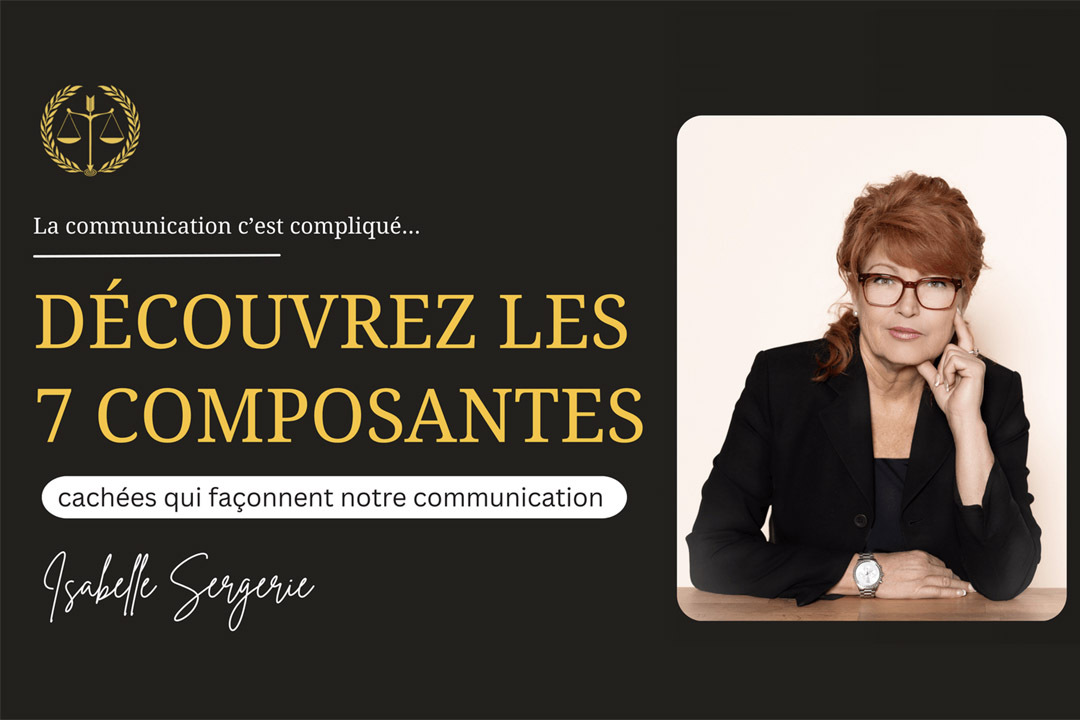

It depends on seven invisible components: emotions, values, intelligences, experiences, nonverbal language…
Understanding these levers is already a first step toward defusing conflicts before they arise.
Isabelle Sergerie, President of Médiation organisationnelle PRD and a mediator in civil, commercial, and workplace settings, explains them to help you better understand why it can sometimes be so difficult to be clearly understood — and to truly understand others.
The 7 hidden components that shape our communication
1. The 8 Multiple Intelligences (Howard Gardner)
Each individual has a unique combination of intelligences: linguistic, logical, kinesthetic, musical, spatial, interpersonal, intrapersonal, and naturalistic.
These dominant intelligences shape the way we learn, understand, and… communicate.
2. The 5 Primary Functions (Dr. Racine)
These functions refer to the basic mechanisms that determine how we process information. Some people analyze, others feel, and some act immediately — all of this influences the dynamics of an exchange.
3. The 5 Emotional Competencies (Daniel Goleman)
Self-awareness, self-regulation, motivation, empathy, and social skills are levers that support (or hinder) our communication. A deficit in any of these areas can quickly create misunderstandings.
4. The 19 Core Values (Schwartz)
Our values act as internal guides. They shape our priorities, reactions, and judgments. When two value systems clash, communication can become a minefield.
5. Personal Experience
Our life stories, successes, wounds, and lessons leave a lasting imprint. Everyone approaches a conversation carrying this invisible baggage, which colors their perceptions.
6. Emotional Quotient (EQ)
Often underestimated, EQ plays a major role in the quality of human relationships. The higher it is, the better one can manage their emotions, decode others’ emotions, and create authentic communication.
7. Nonverbal Language
Words represent only part of the message. Gestures, posture, facial expressions, and tone of voice play a key role in validating (or contradicting) what is said. Nonverbal cues are the truth detector of communication.
Once you start understanding these components, it becomes easier to decode others’ profiles and adapt your communication, making exchanges smoother and simpler for everyone.
Take it further…
Want to learn more and take advantage of the holiday season to train yourself? Explore all of her courses by clicking here.
Read Isabelle Sergerie's full official article: